" height="18px" id="mDJPTPAnZ" transform="translate(4 7)" width="24px"/></svg>)
" height="20.00111219075793px" id="Q8AnWij7S" transform="translate(5.999 5.999)" width="20.00111219075793px"/></svg>)
How to evaluate engineering candidates in the age of AI (Yes, it’s still possible.)
The rise of AI is redefining workforce expectations. Candidates understand that, and are leaning on LLMs as a tool to help meet and exceed them. Employers, on the other hand, are much less confident (and notably less optimistic) about AI’s impact on hiring.

CEO & Founder
(This article was originally published on LinkedIn)
In the employer vs. candidate AI battle, more and more HR managers are simply giving up on take-home assessments altogether.
“If candidates all use AI, we can’t accurately validate technical skills with virtual tests or assessments anymore,” many complain. Though, that mindset existed even before AI, given the advent of Google Search.
The widespread perception is that online tests don’t work because even unskilled candidates can get around them, and worse, can often do so undetected.
Resumes can’t be relied on because so many are AI enhanced, if not altogether AI-generated.
And even when explicitly asked not to, candidates are doing whatever it takes to get hired, including cutting corners or actively cheating during virtual assessments.
Hiring managers are frustrated, and understandably so.
Unfortunately, the answer many have turned to is to revert back to what once worked well: conducting interviews and assessments in person. But in 2026, it’s an outdated, expensive, and entirely unscalable solution to a still-evolving problem.

What happens when we believe AI can do it all, except maintain the integrity of technical hiring?
The rise of AI is redefining workforce expectations. Candidates understand that, and are leaning on LLMs as a tool to help meet and exceed them. Employers, on the other hand, are much less confident (and notably less optimistic) about AI’s impact on hiring.
The fundamental tension at hand comes into play when candidates use AI to inflate or entirely fake skills rather than showcase those they have. It’s a “workaround” as many as 32% of candidates own up to, though realistically, the number of candidates doing so (whether they admit to it or not) far exceeds that estimate.
It all points to a growing trend where candidate AI usage is getting more sophisticated, all while hiring processes devolve in the absence of it.
But the real problem is that, collectively, our faith in hiring processes has been shaken to the point that running in-person interviews when you have 1,000+ candidates to screen per role seems like a sensible choice.
The consequences of an outdated technical hiring playbook in an evolving market
It’ll only take five minutes to spot an unqualified candidate during an in-person interview, but by then, you’ll have spent $1,000+ in engineering time per candidate, with another 85 minutes left in the interview. Rinse and repeat 999 times. It’s nearly impossible to do, and at scale, becomes astronomically expensive.
Things start to look even more bleak when you realize that technical candidates are now being assessed manually, individually, and in person in 2026. All the while, the tools and technologies designed to automate them sit untouched or abandoned.
But is it truly indicative of a tooling quality problem? Or have hiring managers simply gotten stuck in their own skepticism and in turn, stopped believing talent evaluation platforms can do what they need?
What assessing engineering candidates in 2026 should look like
The skills that made a great hire in 2020 aren't the same ones that matter today.
Platforms like Coderbyte have evolved alongside the market, releasing new features using AI to combat AI regularly. With Coderbyte:
AI resume grading takes the guesswork out of screening and shortlisting engineering candidates with the right skills, not just the ability to write code (You even get an evaluation of each resume, as a report, to support faster screening decisions that don’t require engineering support).
AI webcam proctoring lets you flag suspicious activities, like going off-screen or having an AI assistant in view, so the integrity of your assessments remain intact.
For employers, it means smarter, easier ways to detect cheating, assess AI fluency, and test for real-world skills. For one Coderbyte customer handling massive candidate volumes per role, over 90% of candidates were flagged for cheating during an assessment: an invaluable shortlisting shortcut and a guarantee you can’t get if you’re doing it all manually.
The potential, the capabilities, and the opportunity for HR teams to adopt AI better are there.
But teams’ confidence to dive in and make the most of them haven’t yet caught up, even when the average cost-per-hire for Coderybyte customers is a proven $1500 less per candidate compared to companies hiring manually.
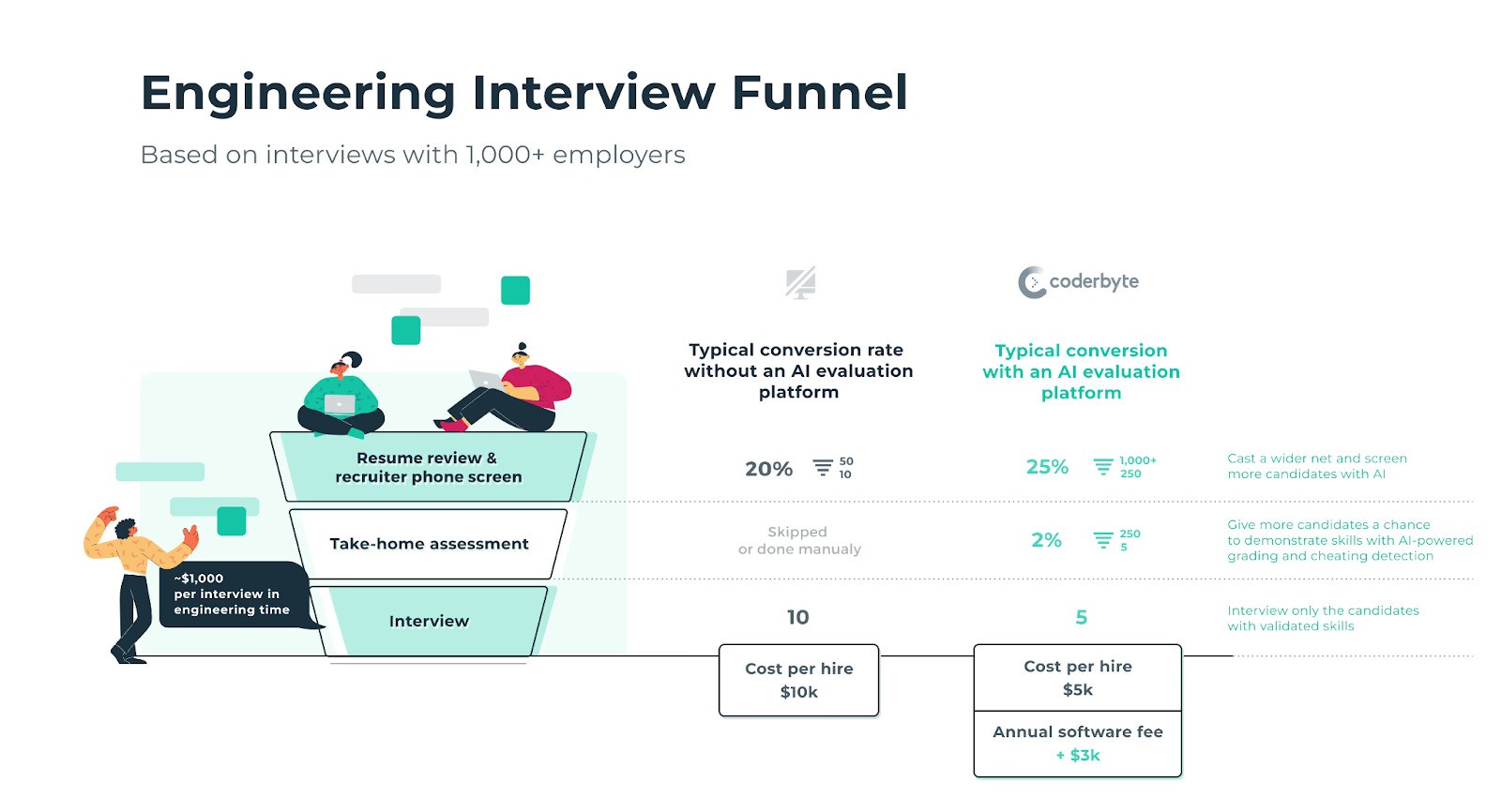
For candidates, Coderbyte means interviews that suck less and that actually test your abilities, not your ability to interview well. We’re making coding interviews realistic, testing for AI fluency —not dependency— by allowing as-necessary ChatGPT usage during assessments, plus gauging interpersonal skills.
Candidates land the right job for their skills, and employers can both screen out unqualified candidates while finding the best-fit candidates faster.
The key to evolving with, not resigning to, an AI-riddled hiring market
Today, nearly two-thirds of tech leaders agree it’s more complex to hire skilled professionals than it was just a year ago, and just 7% feel confident in their ability to fill even the most in-demand roles.
Some point fingers at candidates. Others blame AI. No progress will happen though, without an explicit effort to evolve with the times rather than resign to them. And quite the opposite of progress will happen if employers continue to revert back to the old way of hiring, simply because the smarter way hasn’t quite been figured out yet.
Technical hiring isn’t broken, and once you’ve gotten halfway to a solution, it isn’t the time to quit and accept defeat. AI tools and talent evaluation platforms like Coderbyte have already started paving the way toward the future of hiring, but hiring teams aren’t yet all taking intentional steps to get there.
There’s a path forward, but it starts with putting our faith back in hiring, and embracing fit-for-purpose tools with more confidence.
Get in touch to learn how Coderbyte helps HR leaders catch up with the future of hiring.
" height="18px" id="bfgxjBcLr" transform="translate(1 1)" width="18px"/></svg>)
" height="18px" id="NKz1zJmxh" transform="translate(1 1)" width="18.000000922527658px"/></svg>)
" height="15.998999999999999px" id="lQ6Zl3KpL" transform="translate(0 2)" width="19.999px"/></svg>)
" height="17.875px" id="OnwM9Gbe_" transform="translate(0 1)" width="19.775px"/></svg>)