" height="18px" id="mDJPTPAnZ" transform="translate(4 7)" width="24px"/></svg>)
" height="20.00111219075793px" id="Q8AnWij7S" transform="translate(5.999 5.999)" width="20.00111219075793px"/></svg>)
If everyone can vibe code, why are organizations hiring more software engineers than before AI?
With just some simple prompting, AI can now produce thousands of lines of code per minute. And it’s led to a ubiquitous narrative that doubles as a looming threat: that AI is set to eliminate the white collar-workforce, particularly in tech, and replace engineers.

Sales
(This article was originally published on LinkedIn)
With just some simple prompting, AI can now produce thousands of lines of code per minute. And it’s led to a ubiquitous narrative that doubles as a looming threat: that AI is set to eliminate the white collar-workforce, particularly in tech, and replace engineers.
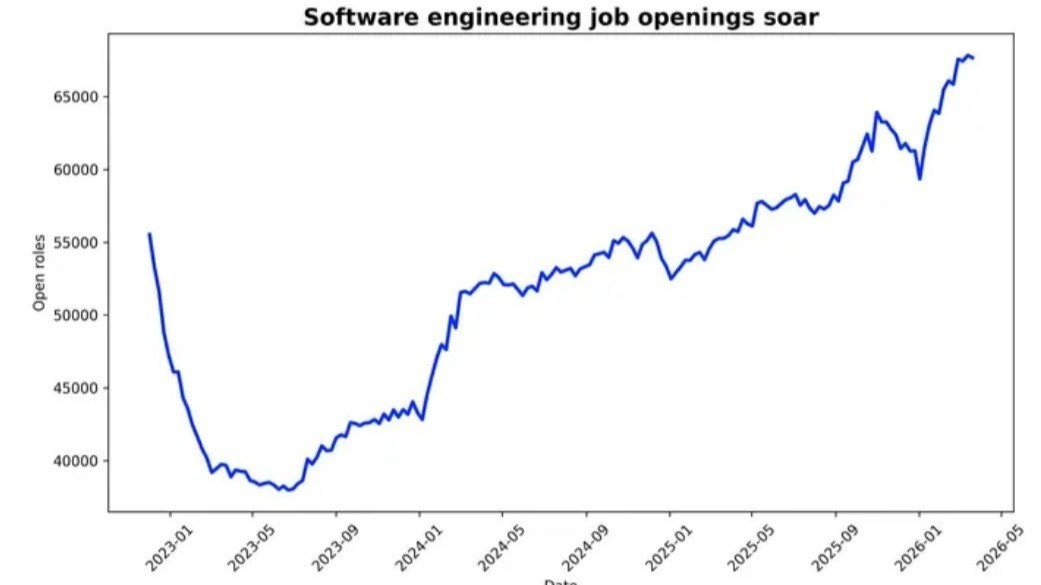
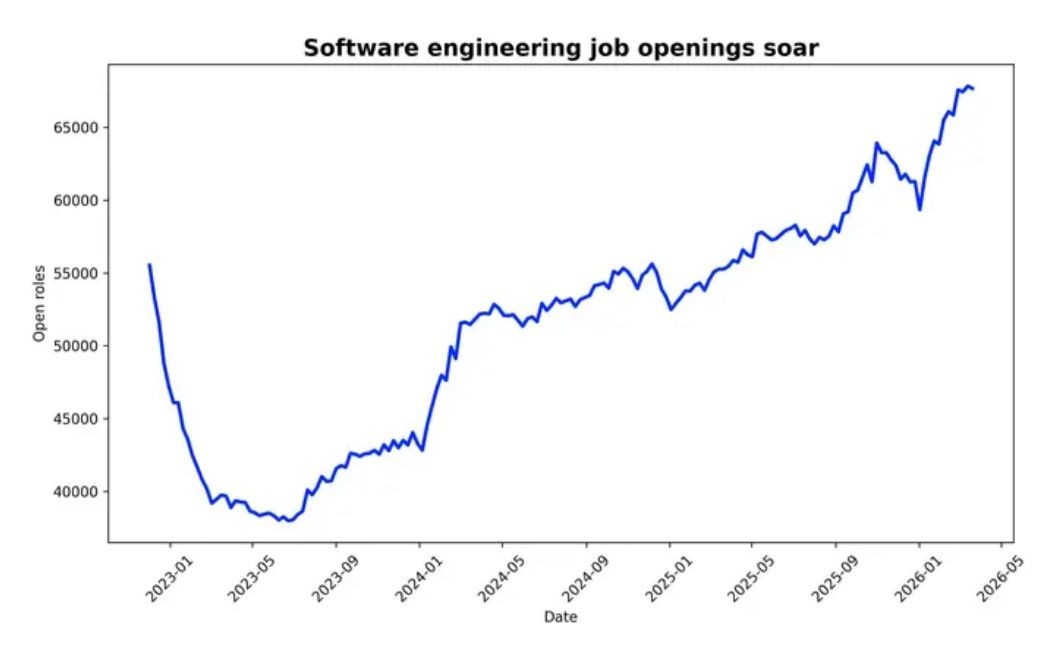
In the reality of today’s market, the prevailing message is one that couldn’t ring less true. (The headline? The impending death of software engineering jobs has been wildly exaggerated.) Yes, AI can write your code. But that’s only part of what engineers do, which is why in spite of the rise of AI code generation, AI-enhanced resumes, and AI-assisted interviewing, software engineering job openings are up. Demand is sky-high for strategic, business-minded, process-designing engineers for whom coding is just a fraction of what they bring to the table.
Here’s how one engineer explains it:
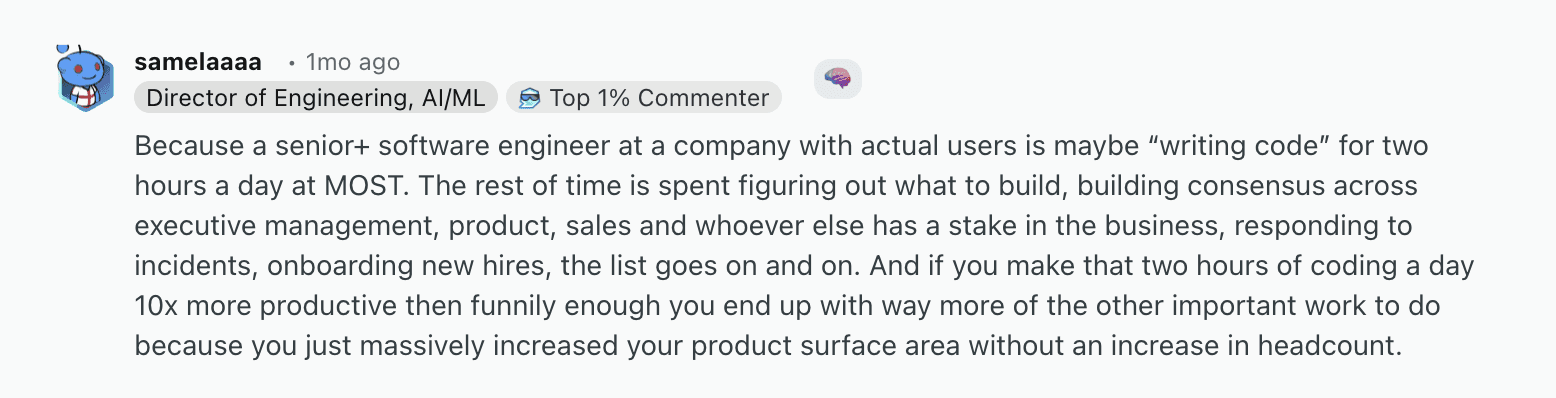
Skilled engineers haven’t gone extinct in the face of AI, but with how difficult finding and hiring them is becoming for HR teams, it may feel like they have.
What hiring teams can do when demand for top candidates is high, but hiring confidence is low
When everyone can be a coder (or pretend to be a coder) with AI, how do you find and hire skilled, seasoned engineers with the right expertise? Hint: they’re the ones who admit that the hardest part of the job is never just writing code, but things like understanding business requirements, building processes, and writing the most optimized and reusable code.
Job postings for software engineers have roughly doubled since mid-2023 at tech companies, and have jumped about 30% this year so far, according to Business Insider. That means that, by default, hiring teams are almost always dealing with candidate pools at scale, and that high-volume, high-stakes hiring is now just the name of the game.
Fighting AI with with AI is the obvious next step for many hiring teams, but as one Reddit user put it, the challenge is that HR teams have the right tools at their disposal, yet “90% of the time, they don't even know what the problems are that they're trying to solve with AI”. And understandably, you can’t put a solution into action if you’re not even sure what problem you’re solving.
In short, simply using AI as a hiring manager doesn’t guarantee you’ll use AI well. But doing it right? Well, it comes with a big payoff (like a revenue boost of 5-10% or more, estimate most executives).
Injecting AI into hiring blindly won’t guarantee better outcomes. Here’s what will.
Experts suggest we are at a crucial moment where HR leaders need to rethink how they approach technical hiring altogether. But hiring teams are so inundated with hundreds or even thousands of resumes per role, they’d argue there’s no time for a reimagining of much at all.
Time is getting wasted, day in and day out, screening or interviewing unqualified candidates. More candidates in the pipeline are failing than passing, making hiring feel like trying to find a diamond in the rough. And unskilled candidates’ shortcomings are becoming so obvious so soon that hiring teams are opting to end interviews early (yet they’re still unable to accurately gauge when that will happen until their time has already been wasted).
Hiring teams are doing what they can manage, and that’s adopting AI in any way that might make their jobs easier or more efficient. But for a large percentage of HR leaders, it’s a spray-and-pray approach that’s more of a shot in the dark than a strategic implementation of AI tooling.
Crossing their fingers and/or blaming the candidates won’t solve the issue either (and as the data proves, that problem is pretty major).
SHRM's 2026 State of AI in HR report found that 39% of organizations have adopted AI in HR, with recruiting as their top use case. Some estimate that number is even higher.
Still, companies report difficulty filling roles, and average cost-per-hire sits at $5,475.
As a result, 9 in 10 recruiters plan to ramp up their AI usage even further in 2026.
Regardless of where AI adoption actually sits right now, one thing is certain: it’s only going up, and hiring is well overdue for a real, meaningful AI strategy.
The difference between adopting AI for hiring and using it well, at scale? Purpose-built technology.
Doing AI wrong, even if it feels like you’ve satisfactorily checked the AI box, can come at a cost. For many, that just means going in blind and hoping for the best.
A July 2025 Gartner survey found that only 14% of HR leaders feel they do not face any challenges in driving effective use of AI across their team. This struggle could explain why the majority of companies are not actually realizing the return on investment of the AI they're deploying.
With purpose-built AI technologies like Coderbyte, you can implement AI into your hiring processes in the ways that truly matter. And an added bonus? The average cost-per-hire for Coderybyte customers is $1,500 less per candidate compared to companies hiring manually.
Here are a few questions for hiring teams to ask themselves if they want to work better with AI:
1. Are you building your assessments around the job, or around your talent evaluation platform's defaults?
Generic coding puzzles don't tell you much about whether an engineering candidate can scope a business problem, design a system, or write code that's actually easy to maintain.
With Coderbyte, you can paste a job description and generate a tailored assessment from it using AI, so what you're testing actually maps to what the role demands, without any of the manual lift.
2. Do you know which candidates are leaning on AI in ways that hide real skill gaps?
AI-assisted resumes and AI-assisted interview prep have made it near-impossible for hiring teams to separate meaningful signals from noise.
Coderbyte builds cheating detection, webcam proctoring and prompt engineering challenge modes into assessments, so you can flag when users are using AI assistants unfairly, but also gauge their AI fluency. You can even use ChatGPT within the IDE of your live interview with a candidate or in take-home projects, and see in real-time how candidates think, reason, and make use of AI tools to work better, faster, and smarter. Remember: the goal isn't to pretend AI doesn't exist and simply hope candidates don’t cheat or fake their skills, but to understand exactly where each candidate stands with and without AI.
3. How much recruiter time is getting eaten up by candidates who clearly aren't qualified?
If your team is ending interviews early on a regular basis, the screening stage isn't working. If you’re considering taking interviews back to in-person, in-office formats, it’s even more broken than you think.
Coderbyte lets you use AI to filter candidates before they ever get to a live interview, and then assess them accurately after. (Think: AI resume grading, candidate reports, and soon, phone screens.) Plus, with unlimited candidate invites, you're not forced to make guesses at the top of the funnel just to manage volume.
—
And that’s just a teaser. Want to explore our AI capabilities in full, or try Coderbyte for yourself? Get a free trial or reach out for a demo.
" height="18px" id="bfgxjBcLr" transform="translate(1 1)" width="18px"/></svg>)
" height="18px" id="NKz1zJmxh" transform="translate(1 1)" width="18.000000922527658px"/></svg>)
" height="15.998999999999999px" id="lQ6Zl3KpL" transform="translate(0 2)" width="19.999px"/></svg>)
" height="17.875px" id="OnwM9Gbe_" transform="translate(0 1)" width="19.775px"/></svg>)